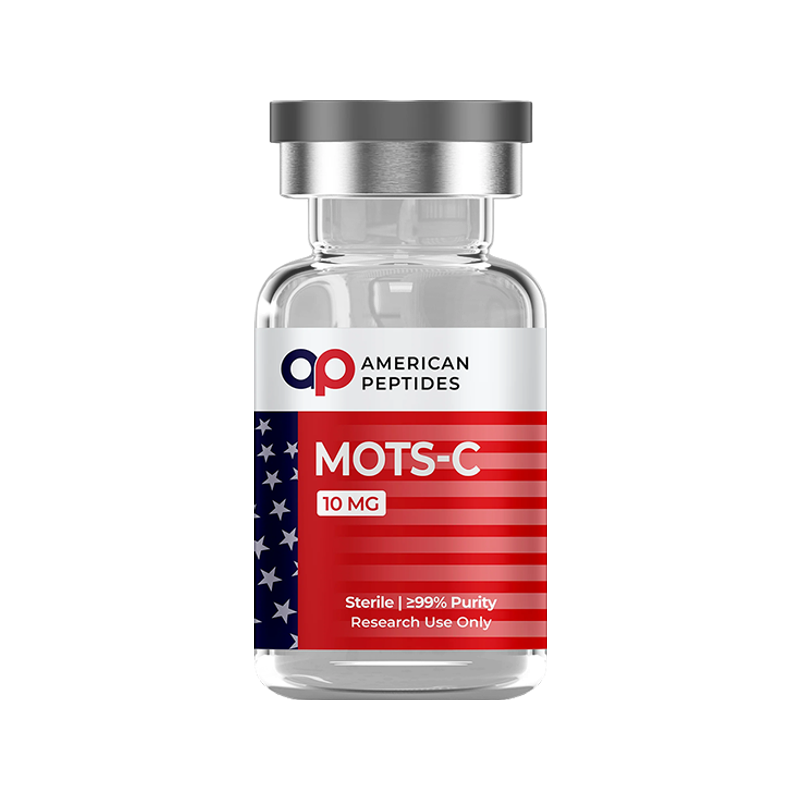
Research-use-only context. This article summarizes published third-party scientific literature — the large majority of it conducted in cultured cells or animal models. It is not medical advice, not a therapeutic or performance claim, and not a usage guide. American Peptides products are sold strictly for in vitro laboratory research and are not for human or veterinary use.
MOTS-c belongs to a newer class of molecules — mitochondrial-derived peptides, short peptides encoded within mitochondrial DNA. It became a significant research topic almost overnight after a landmark 2015 paper. This summary surveys what the peer-reviewed studies report and where the evidence stands. For the format used across this series, see our BPC-157 research review.
What MOTS-c is
MOTS-c is a 16-amino-acid peptide encoded within the mitochondrial 12S rRNA region — part of a small family of mitochondrial-derived peptides that has reframed how researchers think about mitochondria as signaling hubs, not just power plants.
What the research reports
The foundational 2015 Cell Metabolism paper reported that MOTS-c promotes energy-pathway homeostasis and reduces obesity and insulin resistance in mouse models. A 2018 Cell Metabolism study reported that MOTS-c translocates to the nucleus to regulate gene expression under nutrient-deprivation conditions — an unusual finding for a mitochondrial peptide — and a 2016 study examined its role in muscle and fat metabolism. Reviews since then survey candidate roles in metabolism and aging. These are cell and mouse findings.
The human-evidence gap
MOTS-c is a young research area, and the evidence is almost entirely cell- and animal-based. Human-relevance work — for example, associations with exercise response — is emerging, but controlled human efficacy trials are lacking, and MOTS-c is not an approved drug.
The takeaway
MOTS-c anchors a fast-growing, mechanistically rich preclinical field centered on mitochondrial metabolism and adaptive signaling. The human data, so far, are minimal.
Frequently Asked Questions
What is a mitochondrial-derived peptide?
A short peptide encoded within mitochondrial DNA. MOTS-c is one of the most-studied, encoded in the 12S rRNA region.
What did the 2015 MOTS-c study find?
The Cell Metabolism paper reported that MOTS-c promoted energy-pathway homeostasis and reduced obesity and insulin resistance in mouse models.
Is MOTS-c research done in humans?
It is mostly cell and animal work; human-relevance studies are emerging, but controlled efficacy trials are lacking.
How does MOTS-c act in studies?
Studies describe energy-pathway regulation (including AMPK-related signaling) and, under nutrient-deprivation conditions, translocation to the nucleus to influence gene expression.
Citations
- Lee C, et al. “The mitochondrial-derived peptide MOTS-c promotes energy-pathway homeostasis and reduces obesity and insulin resistance.” Cell Metab. 2015;21(3):443–454. PubMed: PMID 25738459
- Kim KH, et al. “The Mitochondrial-Encoded Peptide MOTS-c Translocates to the Nucleus to Regulate Nuclear Gene Expression in Response to Nutrient Deprivation.” Cell Metab. 2018. PubMed: PMID 29983246
- “MOTS-c: A novel mitochondrial-derived peptide regulating muscle and fat metabolism.” Free Radic Biol Med. 2016. PubMed: PMID 27216708
- “MOTS-c: A promising mitochondrial-derived peptide for therapeutic exploitation.” Front Endocrinol. 2023. PubMed: PMID 36761202
Related reading: For the biology behind why rest drives recovery — and how this research fits into it — see The Biology of Sleep and Recovery: How Rest Repairs the Body.
Related reading: For the biology of metabolism and appetite behind this research — and how it all fits together — see Why We Gain Weight: The Biology of Metabolism, Appetite, and Gut Hormones.
Related reading: For the biology of aging that ties this research together — the hallmarks, NAD+, senescence, and healthspan — see The Biology of Cellular Aging: Research Pathways.
This article is for laboratory research reference only. American Peptides products are sold strictly for in vitro research. Not for human consumption.
Related research
Compliance Notice: American Peptides products are sold strictly for laboratory and academic research purposes only. They are not intended for human or veterinary consumption, diagnosis, treatment, or prevention of any disease. All content on this page is educational in nature and does not constitute medical advice or product claims. Researchers are responsible for handling these compounds in accordance with their institution’s safety protocols and applicable laws.