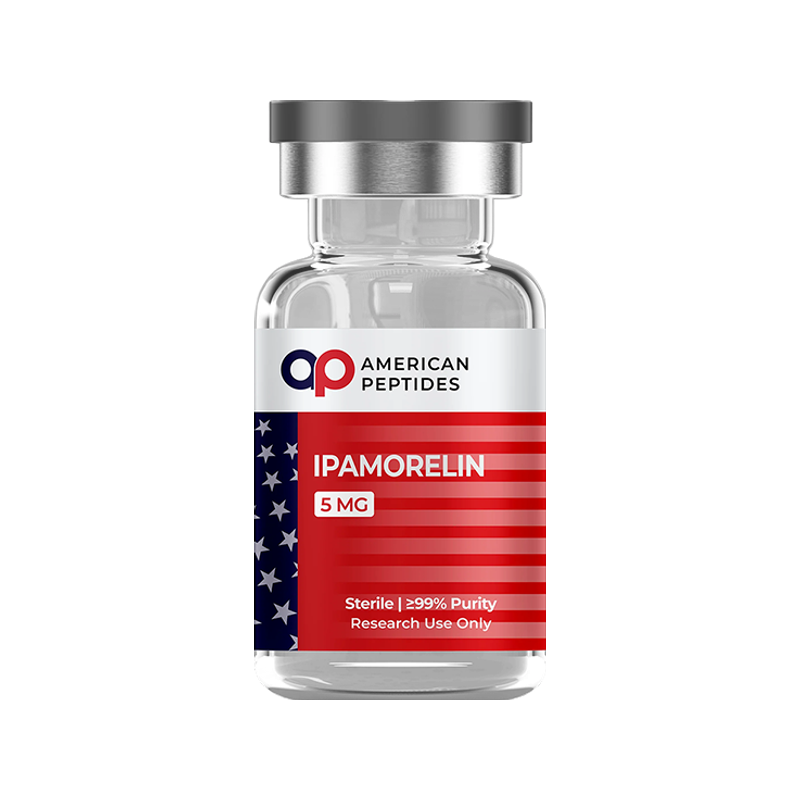
Research-use-only context. This article summarizes published third-party scientific literature — the large majority of it conducted in cultured cells or animal models. It is not medical advice, not a therapeutic or performance claim, and not a usage guide. American Peptides products are sold strictly for in vitro laboratory research and are not for human or veterinary use.
Ipamorelin has a clearer pharmacological pedigree than most research peptides: it was introduced in the late 1990s and characterized in the peer-reviewed literature as the “first selective growth hormone secretagogue.” This summary surveys what the studies actually establish about its mechanism, and where the evidence stops. For the format used across this series, see our BPC-157 research review.
What ipamorelin is
Ipamorelin is a synthetic pentapeptide and a selective agonist of the ghrelin receptor (GHS-R1a). The foundational 1998 paper in the European Journal of Endocrinology described it as selective in a specific sense — releasing growth hormone in models without the broader effects on other pituitary hormones seen with some earlier secretagogues.
What the research reports
A 1999 study reported that ipamorelin “induces longitudinal bone growth in rats.” Unusually for a research peptide, early human pharmacokinetic work exists: a 1999 study modeled its PK/PD in human volunteers, and related work examined nasal absorption. More recent research explores ghrelin-receptor agonists (ipamorelin, anamorelin) in contexts such as chemotherapy-associated weight loss in animal models. These describe pharmacology and preclinical outcomes, not established clinical efficacy.
The human-evidence gap
Despite the early human PK data, controlled clinical efficacy studies for the uses ipamorelin is popularly associated with are limited. Recent 2026 reviews in orthopaedic and sports-medicine journals group it among peptides used ahead of rigorous approval and urge caution. It is not an approved drug, and growth-hormone secretagogues are prohibited in competitive sport.
The takeaway
Ipamorelin is one of the better-characterized peptides at the pharmacology level — a selective GHS-R1a agonist with early human PK. What it lacks is controlled efficacy evidence for its popular uses.
Frequently Asked Questions
What does “selective growth hormone secretagogue” mean for ipamorelin?
The 1998 characterization described growth-hormone release in models without the broader pituitary-hormone effects associated with some earlier secretagogues.
What receptor does ipamorelin act on?
The ghrelin receptor (GHS-R1a), where it acts as a synthetic agonist.
Has ipamorelin been studied in humans?
Early pharmacokinetic studies in human volunteers exist (1999), but controlled efficacy trials for its popular uses are limited.
Is ipamorelin approved by the FDA?
No. It is investigational/research-grade and is prohibited in competitive sport. American Peptides supplies it strictly for in vitro research.
Citations
- Raun K, et al. “Ipamorelin, the first selective growth hormone secretagogue.” Eur J Endocrinol. 1998;139(5):552–561. PubMed: PMID 9849822
- Svensson J, et al. “Ipamorelin, a new growth-hormone-releasing peptide, induces longitudinal bone growth in rats.” Growth Horm IGF Res. 1999. PubMed: PMID 10373343
- Gobburu JV, et al. “Pharmacokinetic-pharmacodynamic modeling of ipamorelin, a growth hormone releasing peptide, in human volunteers.” Pharm Res. 1999. PubMed: PMID 10496658
- “Therapeutic Peptides in Orthopaedics: Applications, Challenges, and Future Directions.” JAAOS Glob Res Rev. 2026. PubMed: PMID 41490200
Related reading: For the biology behind why rest drives recovery — and how this research fits into it — see The Biology of Sleep and Recovery: How Rest Repairs the Body.
This article is for laboratory research reference only. American Peptides products are sold strictly for in vitro research. Not for human consumption.
Related research
Compliance Notice: American Peptides products are sold strictly for laboratory and academic research purposes only. They are not intended for human or veterinary consumption, diagnosis, treatment, or prevention of any disease. All content on this page is educational in nature and does not constitute medical advice or product claims. Researchers are responsible for handling these compounds in accordance with their institution’s safety protocols and applicable laws.