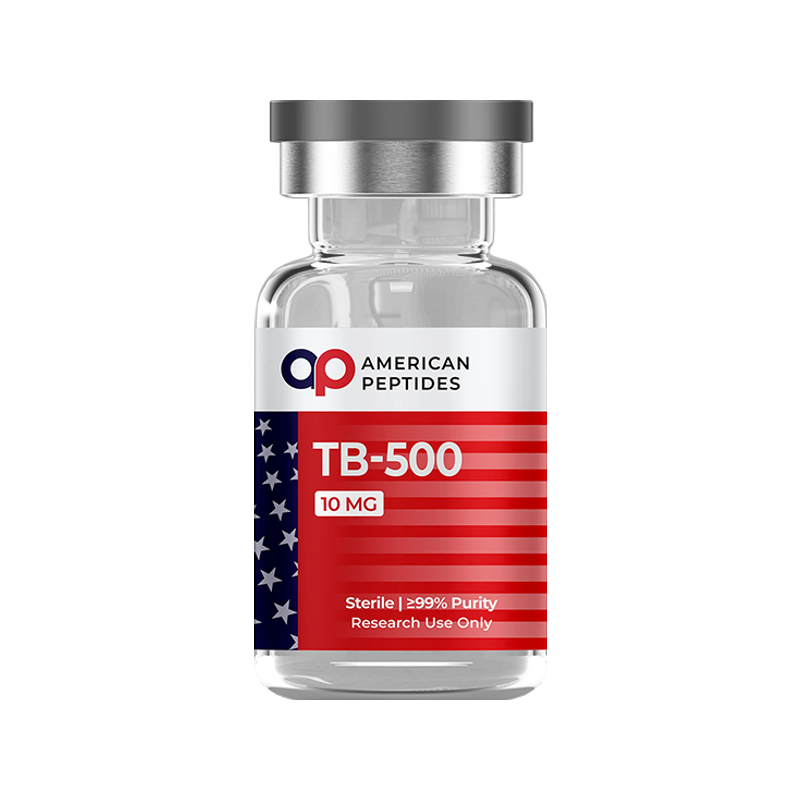
Research-use-only context. This article summarizes published third-party scientific literature — the large majority of it conducted in cultured cells or animal models. It is not medical advice, not a therapeutic or performance claim, and not a usage guide. American Peptides products are sold strictly for in vitro laboratory research and are not for human or veterinary use.
Among regenerative research peptides, TB-500 draws on one of the deepest literatures of all — because it corresponds to the active region of thymosin β4 (Tβ4), a naturally occurring 43-amino-acid protein studied since the 1980s. This summary surveys what the peer-reviewed studies report, how much is preclinical, and where the human evidence thins out. For the evidence-first format used across this series, see our BPC-157 research review.
What TB-500 is
TB-500 is a synthetic peptide corresponding to the actin-binding region of thymosin β4. Tβ4’s best-characterized biochemical role is regulating actin — the cytoskeletal protein cells use to change shape and migrate — by sequestering monomeric G-actin. That single mechanism sits underneath most of what the broader literature explores.
What the research reports
Across cell and animal models, thymosin β4 has been studied for roles in cell migration, blood-vessel formation (angiogenesis), and tissue repair. Review literature describes candidate roles in cardioprotection (2016, Vitamins & Hormones) and in the eye, where a 2018 review traced ophthalmic Tβ4 “from bench to bedside.” Its actin biology has also been examined in the context of sepsis. More recently, a 2025 Stem Cell Reports study used human brain organoids to examine Tβ4 as an Alzheimer’s-disease intervention target, and a 2023 review framed it as a direction for anti-aging regenerative research. Each of these describes findings in cells or animals (or, for the eye, specific clinical formulations) — not general outcomes in people.
The human-evidence gap
Tβ4 has advanced further in a few narrow clinical areas (notably ophthalmic formulations) than many research peptides. But for the systemic “TB-500” uses discussed in fitness circles, controlled human efficacy data are limited, it is not an approved drug for those uses, and it is prohibited in competitive sport under anti-doping rules. The breadth of the preclinical signal should not be read as human proof.
The takeaway
TB-500 rests on a deep, mechanistically coherent literature centered on actin, cell migration, and repair — overwhelmingly in cells and animals. The narrow clinical work is real but specific; the broad regenerative claims remain preclinical.
Frequently Asked Questions
Is TB-500 the same as thymosin beta-4?
TB-500 is a synthetic peptide corresponding to the actin-binding region of the natural protein thymosin β4; the research literature discusses them in closely related contexts.
Is TB-500 research mostly done in animals?
Yes. The systemic regenerative literature is largely rodent and cell-based, although thymosin β4 ophthalmic work has reached clinical study.
What is thymosin β4’s main biochemical role?
It is a primary regulator of actin, sequestering monomeric G-actin and influencing cell motility and cytoskeletal dynamics.
Is TB-500 an approved drug?
No. It is not approved for systemic regenerative use and is prohibited in competitive sport. American Peptides supplies it strictly for in vitro research.
Citations
- Xing Y, et al. “Thymosin beta 4 as an Alzheimer disease intervention target identified using human brain organoids.” Stem Cell Reports. 2025. PubMed: PMID 40816274
- Kleinman HK, Sosne G. “Thymosin β4 denotes new directions towards developing prosperous anti-aging regenerative therapies.” Int Immunopharmacol. 2023. PubMed: PMID 36709593
- “Cardioprotection by Thymosin Beta 4.” Vitamins and Hormones. 2016;102:1–15. PubMed: PMID 27450736
- Sosne G, et al. “Thymosin beta 4 and the eye: the journey from bench to bedside.” Expert Opin Biol Ther. 2018. PubMed: PMID 30063853
Related reading: For the biology behind why joints and tendons ache — and how this peptide research fits into it — see Why Knees Ache: The Biology of Cartilage, Tendons, and Joint Wear.
This article is for laboratory research reference only. American Peptides products are sold strictly for in vitro research. Not for human consumption.
Related research
Compliance Notice: American Peptides products are sold strictly for laboratory and academic research purposes only. They are not intended for human or veterinary consumption, diagnosis, treatment, or prevention of any disease. All content on this page is educational in nature and does not constitute medical advice or product claims. Researchers are responsible for handling these compounds in accordance with their institution’s safety protocols and applicable laws.