Research-use-only context. This article summarizes published third-party scientific literature — the large majority of it conducted in cultured cells or animal models. It is not medical advice, not a therapeutic or performance claim, and not a usage guide. American Peptides products are sold strictly for in vitro laboratory research and are not for human or veterinary use.
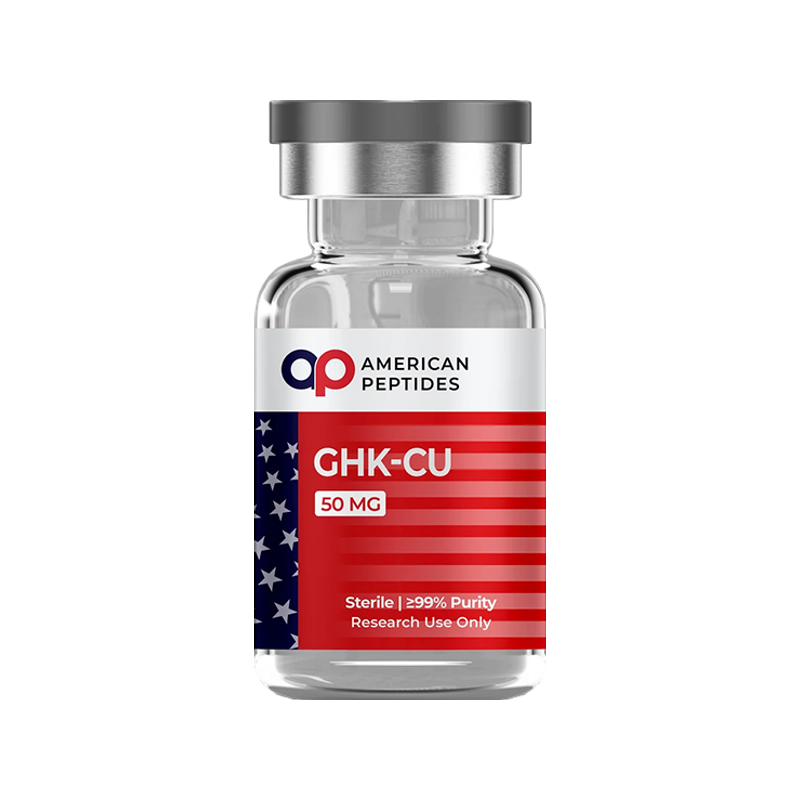
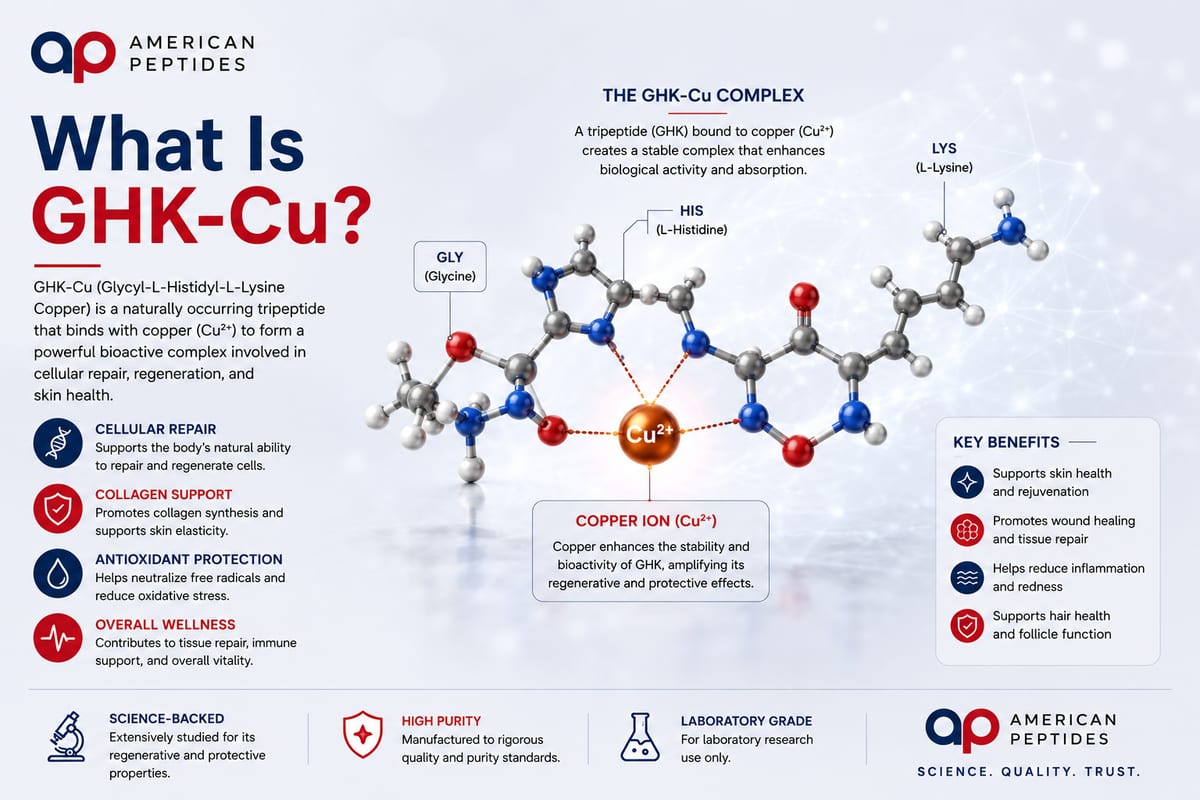
GHK-Cu is unusual among research peptides for how deep its cell-biology literature runs. GHK (glycyl-L-histidyl-L-lysine) is a tripeptide first identified in human plasma; it binds copper(II) to form GHK-Cu, and its concentration declines with age. This summary surveys what the peer-reviewed studies report and where the evidence stops. For the format used across this series, see our BPC-157 research review.
What GHK-Cu is
GHK-Cu is a three-amino-acid sequence bound to a copper(II) ion. Copper binding is central to its studied biochemistry — a 2020 theoretical study examined exactly how the GHK sequence coordinates copper — and much of the research treats the copper complex, not the bare peptide, as the active species.
What the research reports
A widely cited 2015 review describes GHK as a “natural modulator of multiple cellular pathways in skin regeneration,” focusing on gene-expression modulation and extracellular-matrix remodeling; a 2020 review surveys GHK “as an anti-aging peptide.” The research is not limited to skin: a 2016 study reported GHK-Cu reduced lipopolysaccharide-induced acute lung injury in mice, and a 2015 orthopaedic study reported the complex “transiently improved healing outcome” in a rat model of ACL reconstruction — note the authors’ own word, transiently. These are cell and animal findings.
The human-evidence gap
The most rigorous GHK-Cu data are cell-based, animal, or topical-cosmetic. For the musculoskeletal and systemic uses that have made it popular, large controlled human trials are lacking — a point a 2026 Sports Medicine review on approved and unapproved peptide therapies makes directly. GHK-Cu is used in cosmetic products, but that is not the same as an approved therapeutic.
The takeaway
GHK-Cu has a rich, coherent literature in skin biology and gene modulation, with scattered work in other injury models. It is genuinely interesting cell biology — and, for systemic uses, still preclinical.
Frequently Asked Questions
What is GHK-Cu?
A copper-bound tripeptide (glycyl-histidyl-lysine plus copper(II)) found naturally in human plasma, studied mainly for skin-regeneration and gene-modulation research.
Why does GHK need copper?
Copper binding is central to its studied biochemistry; the GHK sequence has high affinity for copper(II), and research generally treats the copper complex as the active species.
Is GHK-Cu research only about skin?
Skin and gene expression is the richest area, but studies also span lung-injury and orthopaedic models — all preclinical or cosmetic.
Is GHK-Cu an approved therapeutic?
No. It appears in cosmetic and research contexts; American Peptides supplies it strictly for in vitro research.
Citations
- Pickart L, Margolina A. “GHK Peptide as a Natural Modulator of Multiple Cellular Pathways in Skin Regeneration.” Biomed Res Int. 2015;2015:648108. PubMed: PMID 26236730
- Pickart L, et al. “The potential of GHK as an anti-aging peptide.” Aging Pathobiol Ther. 2020. PubMed: PMID 35083444
- “Tripeptide-copper complex GHK-Cu(II) transiently improved healing outcome in a rat model of ACL reconstruction.” J Orthop Res. 2015. PubMed: PMID 25731775
- Park JR, et al. “The tri-peptide GHK-Cu complex ameliorates lipopolysaccharide-induced acute lung injury in mice.” Oncotarget. 2016. PubMed: PMID 27517151
Related reading: For the biology behind why joints and tendons ache — and how this peptide research fits into it — see Why Knees Ache: The Biology of Cartilage, Tendons, and Joint Wear.
Related reading: For the biology of aging that ties this research together — the hallmarks, NAD+, senescence, and healthspan — see The Biology of Cellular Aging: Research Pathways.
This article is for laboratory research reference only. American Peptides products are sold strictly for in vitro research. Not for human consumption.
Related research
Compliance Notice: American Peptides products are sold strictly for laboratory and academic research purposes only. They are not intended for human or veterinary consumption, diagnosis, treatment, or prevention of any disease. All content on this page is educational in nature and does not constitute medical advice or product claims. Researchers are responsible for handling these compounds in accordance with their institution’s safety protocols and applicable laws.